
Why AI CRMs Still Make You Work
Real ambient systems don't ask. They observe and act.

You get a Slack notification from your "smart" CRM. "Hey, we found a deal at Acme Corp." You click it. You're taken to a dashboard. The system shows you extracted data: company name, contact email, deal stage. Then it asks: Please review and confirm these fields.
You spend five minutes correcting typos, filling in missing data, approving the extraction. By the time you're done, you've spent more time validating the machine than actually selling.
This is the current state of AI-powered CRMs. And the industry is calling it innovation.
The Approval-Loop Trap
Here's what's happening: the AI sales tool industry has settled on a pattern. Extract. Suggest. Wait for Approval. You send an email to a prospect. The AI reads it, identifies the company, suggests a deal stage, predicts the deal size. Then it stops. It waits for you to say: "Yes, that's right."
This is treated as a feature. "Our AI learns from your feedback!" the marketing copy says. "Human-in-the-loop intelligence!"
But here's the uncomfortable truth: you're not in the loop as a decision-maker. You're in the loop as a validator. You've become the backup system for a system that's supposed to back you up.
Every approval step is friction. Every "please review this" is a tiny tax on your time. And when you're a salesperson juggling a pipeline of 50+ deals, those taxes add up.
Most AI sales tools are built by people who've never sat in a sales role. They see CRM data as a quality problem. "Let's add AI to improve accuracy," they think. But they're solving the wrong problem. The problem isn't accuracy. The problem is interruption.
What Actually Matters to a Salesperson
- Context, not suggestions. When you walk into a meeting with Sarah from TechCorp, you need to know: When did I last talk to her? What did we discuss? What's the relationship momentum? Not: "We think this is a $50K deal (please confirm)."
- Information at the moment you need it. Not a notification asking you to do something. Not a dashboard tab you have to click into. Information that surfaces when you're actually in that workflow.
- Systems that respect your time. Every interaction with the CRM should be removing friction from selling, not adding it.
The irony: the more "intelligent" these tools become, the more they ask of you. More approvals. More corrections. More "please confirm" prompts. Real intelligence would be invisible.
What Ambient Actually Means
An ambient system isn't a chatbot. It's not an "AI coworker." It's not asking you questions. An ambient system works like this:
- Observe. It watches your existing workflows. Your email inbox, where you're already communicating with customers. It doesn't ask you to adopt a new tool or a new process.
- Extract. It transforms unstructured communication into structured intelligence. Companies, people, relationships, momentum. All automatically.
- Surface. It shows you only what needs attention. Not everything. Not suggestions waiting for your approval. Only genuine exceptions and anomalies. A relationship going cold. A deal stalled longer than expected. A customer you've lost touch with.
- Act. It operates invisibly. You don't approve things. You don't validate extractions. You don't chat with an interface. It just works.
This is fundamentally different from the approval-loop model. And it requires a different kind of architecture.
Most CRM companies can't build this because they're starting with a CRM and bolting on AI. They still think in terms of records, forms, and workflows that require human input. Adding AI to a broken process just makes it a broken process with AI.
But what if you built from first principles? What if you started by asking: "How can we capture relationship intelligence without asking salespeople to do anything differently?" That's when you get ambient.
Why This Distinction Matters More Than You Think
There's a fork in the road for AI in enterprise software. On one side: approval-based systems. Extract, suggest, wait. On the other side: truly ambient systems. They observe, extract, surface. No approvals. No validation steps.
The first kind feels safer. The second kind is actually more powerful. Because it respects salespeople's most scarce resource: attention.
Every approval loop is a decision you shouldn't have to make. Every validation step is a workflow you shouldn't have to follow. These things aren't features. They're tax.
The Proof Point: What Ambient CRM Actually Looks Like
We built bem CRM to show what's possible when you get the architecture right. And we open-sourced it.
- Observe. bem CRM watches your email inbox. That's it. No new tool. No adoption friction.
- Extract. It identifies companies, contacts, deals, and relationship momentum. Automatically. At scale. Powered by Bem's API primitives.
- Surface. It shows you a dashboard organized by exception. Not "here are all your deals" but "here's what needs your attention right now."
- Act. You actually sell. The CRM disappears.
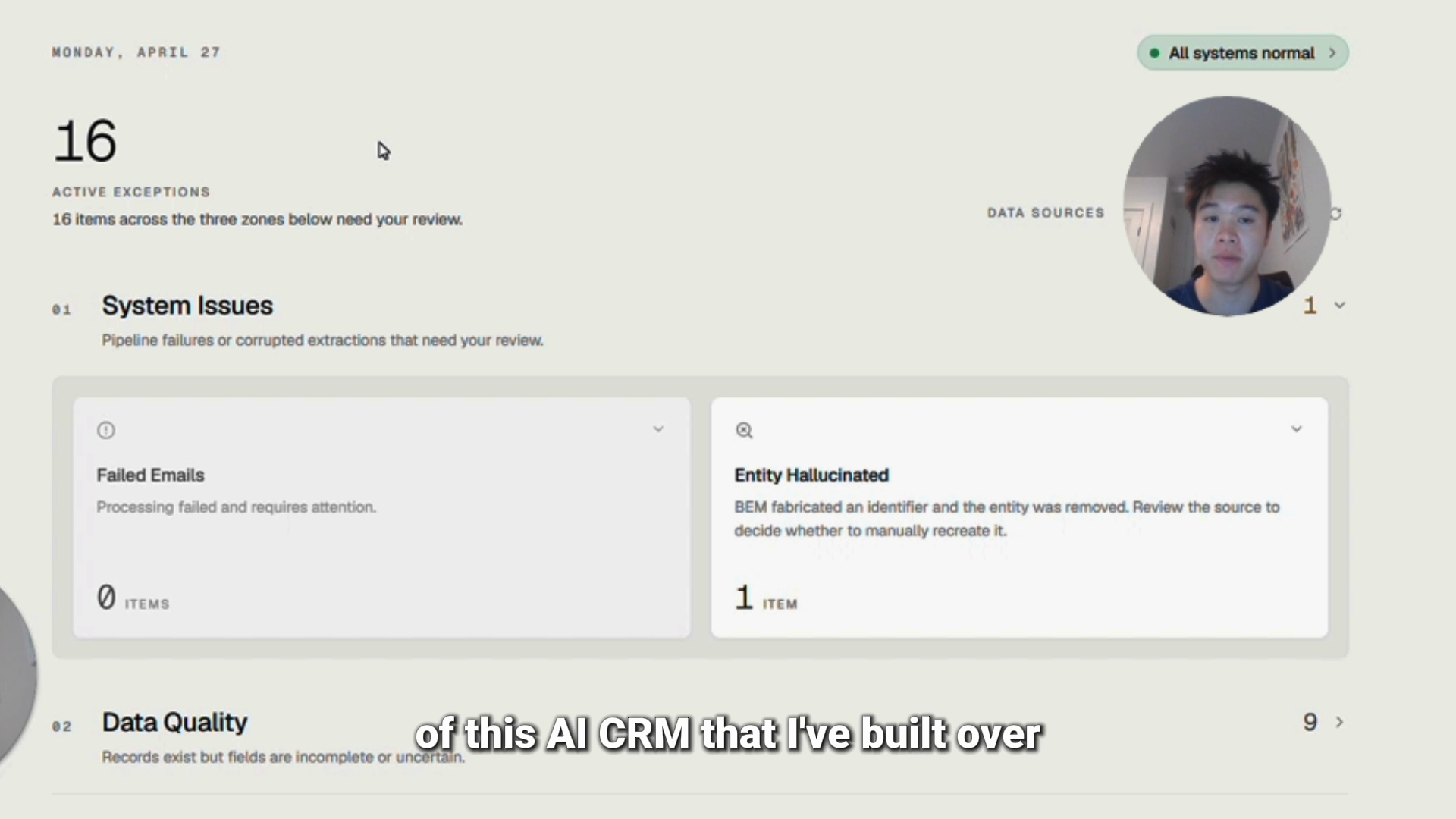
The exceptions dashboard surfaces system issues, data quality problems, and deals that need human intervention.
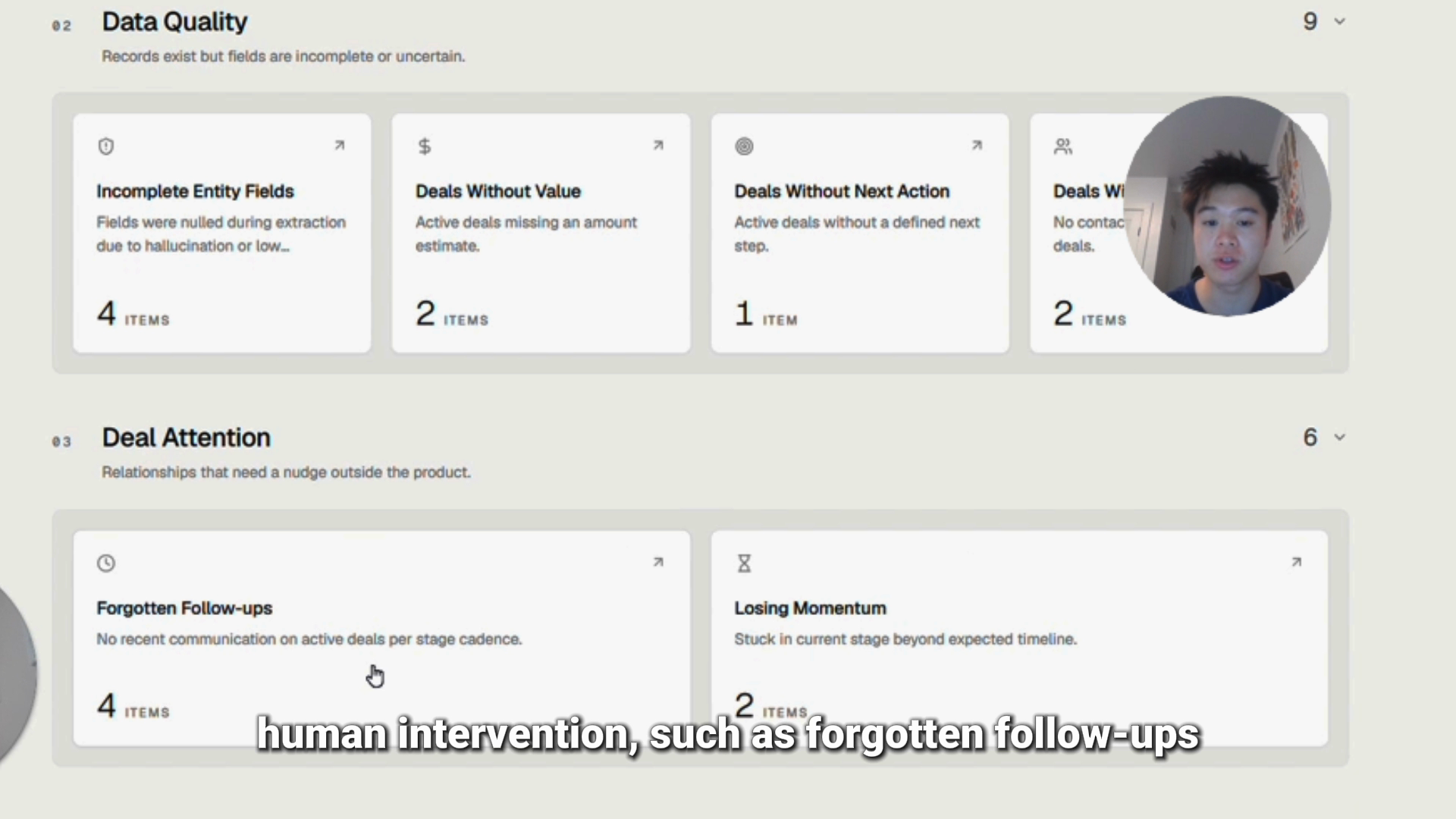
Data quality cards flag incomplete entity fields, deals without values, and deals missing a next action. Deal attention catches forgotten follow-ups and losing momentum.
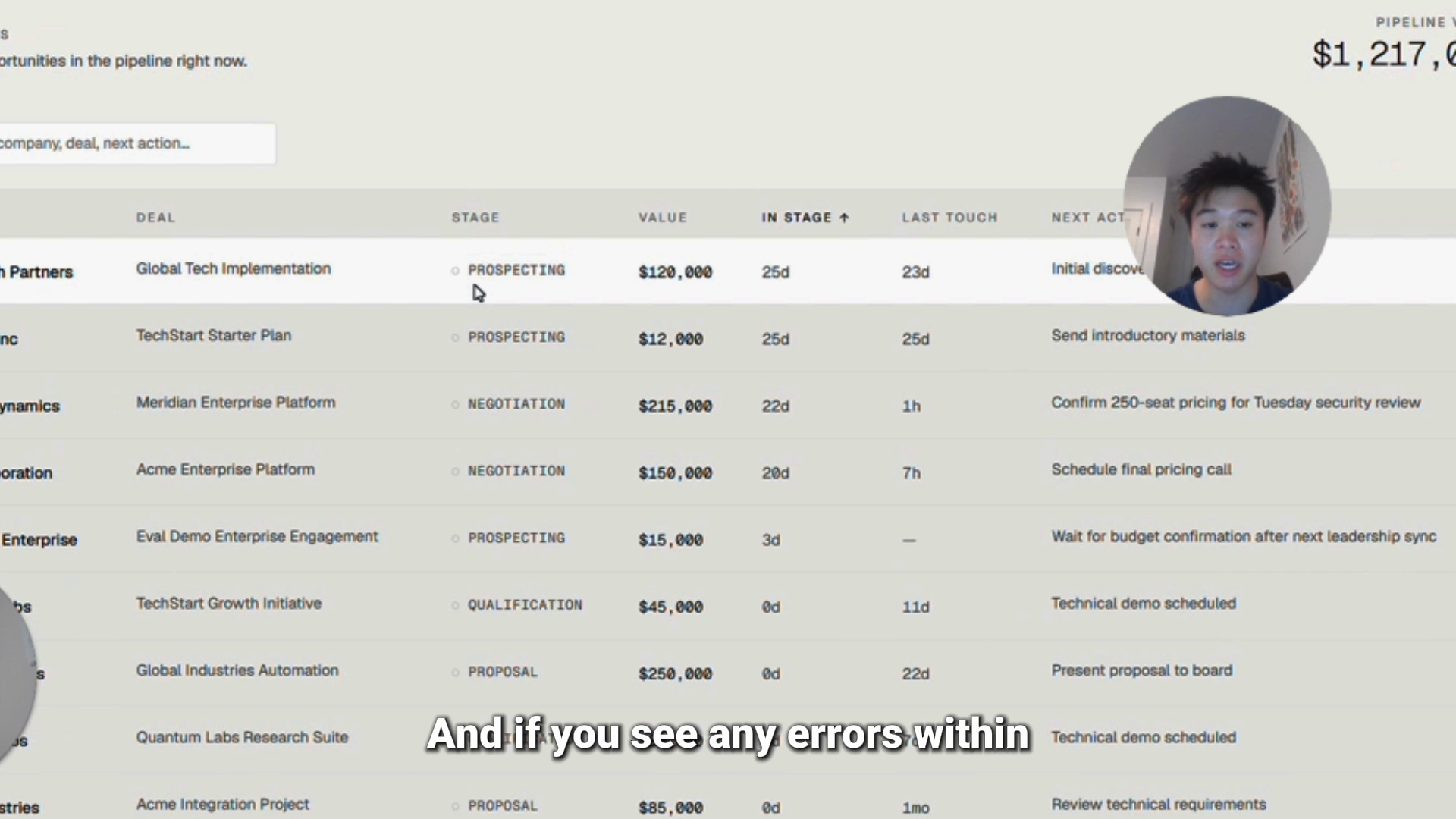
The pipeline view shows every active deal with stage, value, time in stage, last touch, and AI-generated next action.
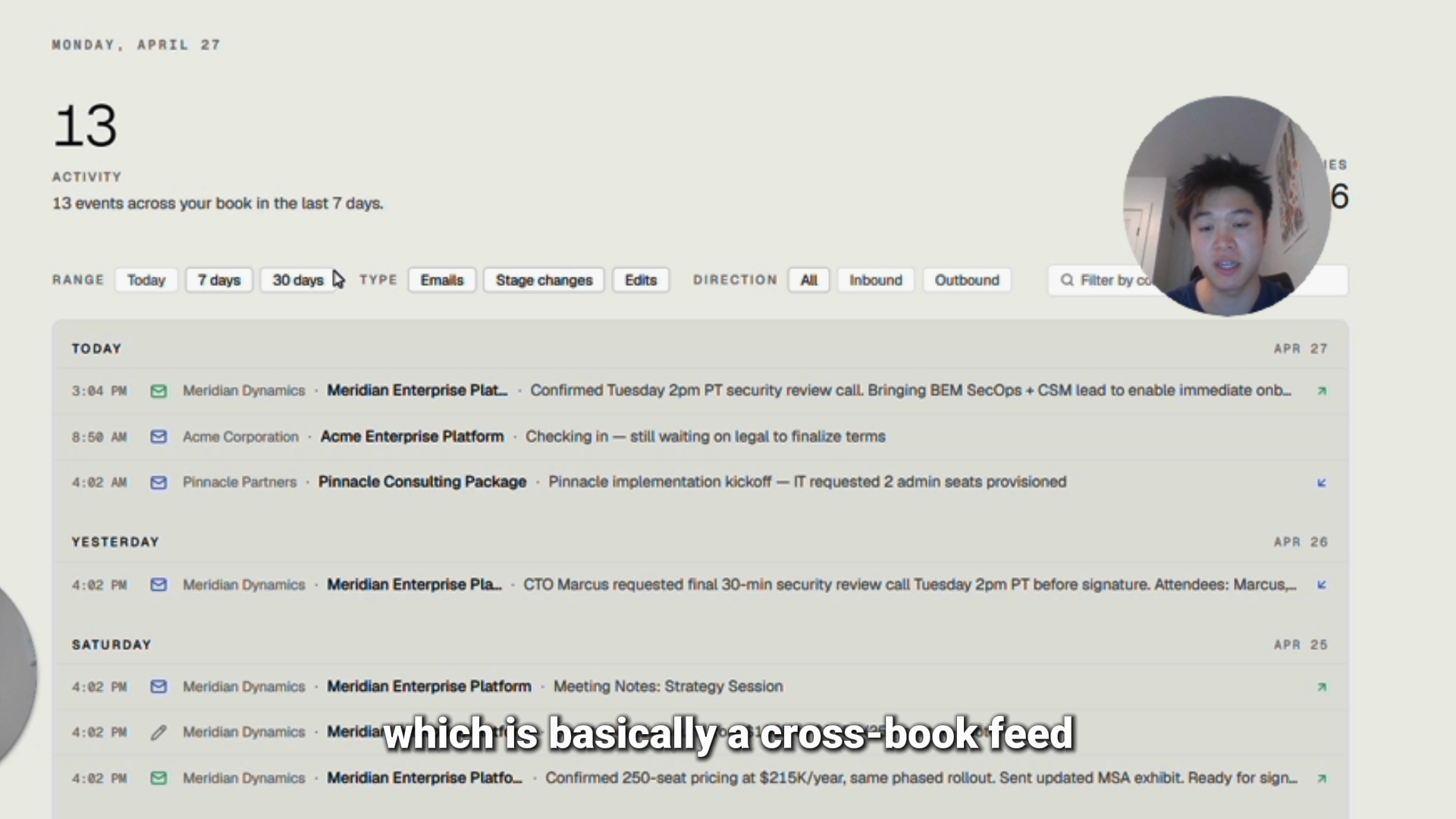
The activity feed tracks every interaction: emails sent and received, stage changes, manual edits. Filterable by time range, type, and direction.
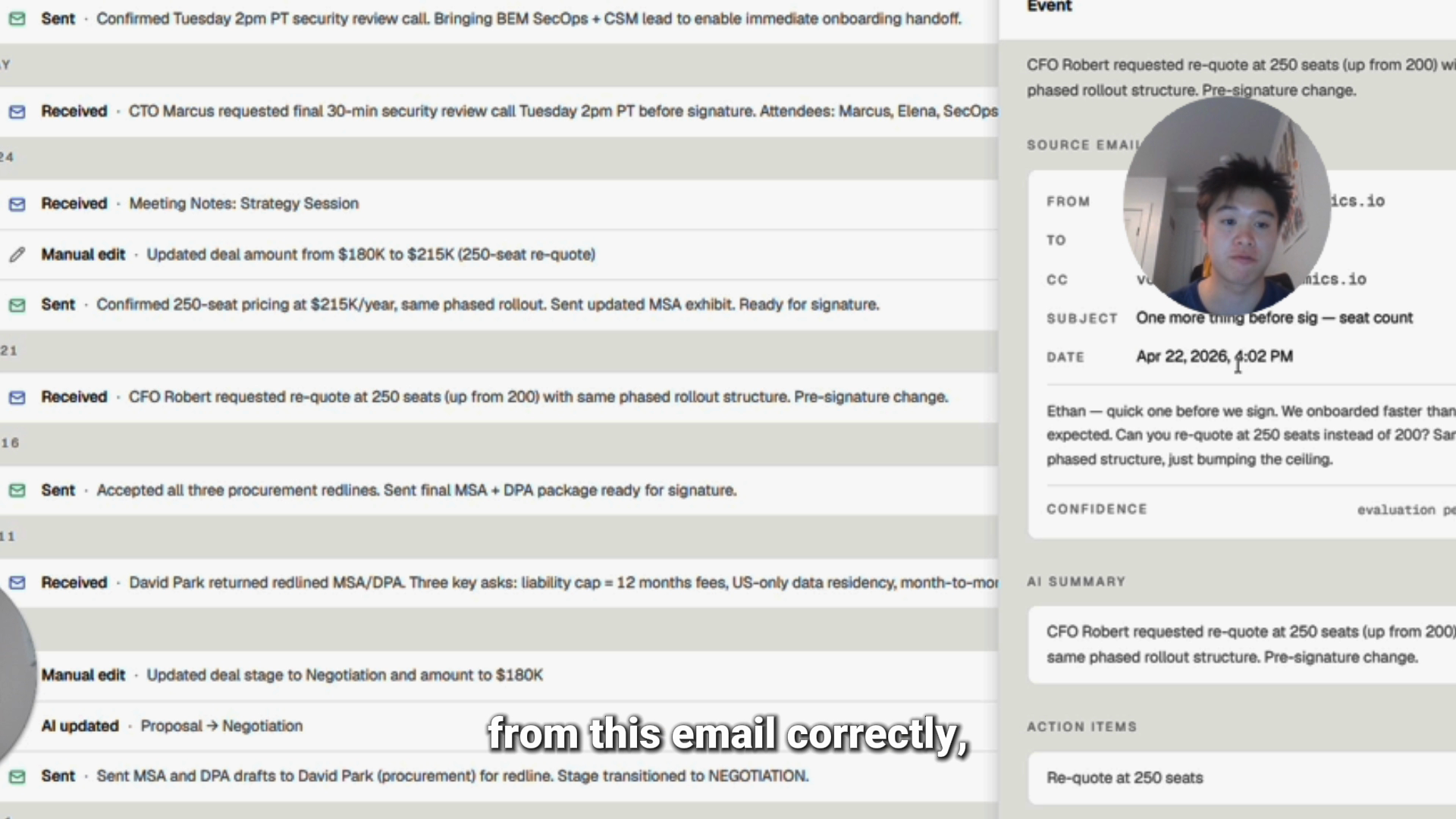
Each deal has a full timeline with source emails, AI summaries, confidence scores, and extracted action items. The AI shows its work on every decision.
Watch the Demo
No "please review this extraction." No "confirm this contact." No chatbot asking what you want to do next. The system observes, extracts, surfaces, then gets out of your way.
And it's only the beginning. Right now, bem CRM observes email. But the architecture supports any ambient input: calendar, calls, documents.
The Bigger Picture
This is the first Bem Labs project. Bem Labs is where we build complete applications on Bem's API and open-source them. Not demos. Production software you can fork, deploy, and use.
The question isn't: "How do we make AI sales tools that ask better questions?" The question is: "What if sales tools didn't ask at all?"
Written by
Ethan Mui
May 1, 2026 · Bem Labs


Ready to see it in action?
Talk to our team to walk through how Bem can work inside your stack.
Talk to the team